Table of Contents
Focus Keyword: R4T-Diffusion SEO
Meta Description: Google’s new R4T-Diffusion SEO query fan-out framework promises faster, more diverse search results. Here’s what it actually means for your SEO strategy.
URL Slug: /r4t-diffusion-seo-google-query-fan-out-framework
R4T-Diffusion SEO: What Google’s Query Fan-Out Framework Means for SEO
Google just published research on a new query fan-out framework called R4T-Diffusion SEO , and if you work in search, you’ve probably already seen the headlines calling it a breakthrough. Before you rewrite your content calendar, let’s talk about what this actually is, why it matters, and — more importantly — what you should and shouldn’t do about it.
I’ve spent years watching Google roll out research papers that sound revolutionary on release day and then quietly fade into “interesting but not urgent” a few months later. R4T-Diffusion SEO might be different. But my first reaction wasn’t to panic or pivot strategy overnight — it was to watch the evidence first.
What Is R4T-Diffusion?
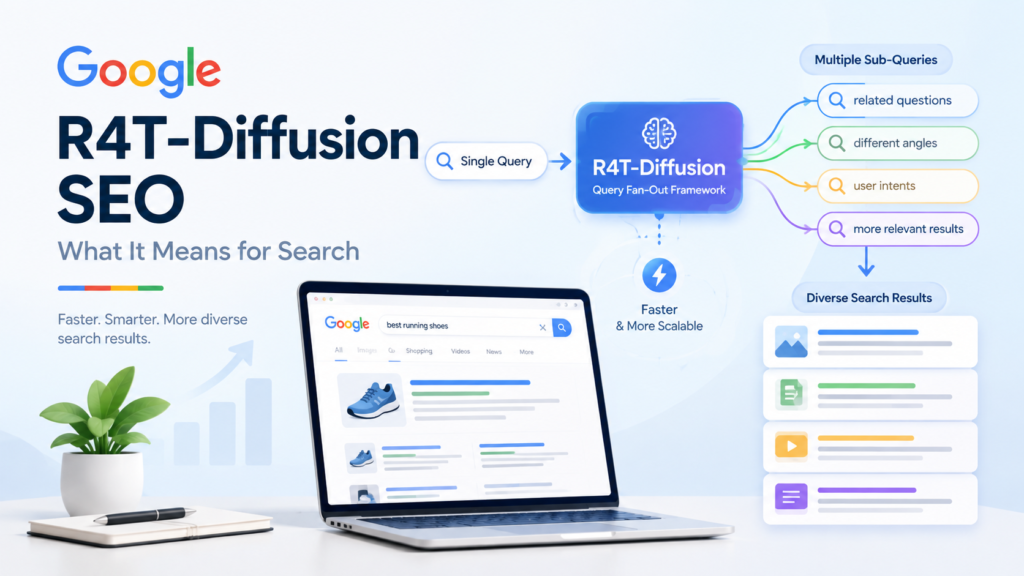
R4T stands for “Retrieve-for-Train,” and the diffusion part refers to the small generative model at the center of the system. In plain terms, Google researchers found a faster, cheaper way to generate high-quality “query fan-outs” — the practice of expanding a single search query into a broader set of related sub-queries so the system can retrieve more relevant, diverse results.
The frame work works in three stages. First, a large language model is trained using reinforcement learning to produce strong fan-out queries based on a weighted mix of goals, like staying grounded to real, retrievable content and avoiding repetitive synonyms. Second, that model’s best outputs are used to generate a large set of training examples. Third, a much smaller diffusion model (around 54 million parameters, tiny by modern AI standards) is trained to replicate that behavior almost instantly.
The result, according to Google’s own researchers, is a system that keeps fan-out quality high while cutting query-time latency dramatically — by an order of magnitude, based on their published benchmarks.
Why R4T-Diffusion SEO Matters for AI Search
For R4T-Diffusion SEO, the important shift is understanding that search engines may explore multiple related queries instead of relying on a single search phrase.If you’ve been tracking how AI Overviews and AI Mode generate answers, query fan-out is already part of the process — Google breaks a single search into multiple sub-queries to pull together a more complete answer. R4T-Diffusion doesn’t create fan-out; it makes it faster and more scalable, which means it’s more likely to show up broadly across search experiences rather than staying limited to specific AI features.
That’s the part worth paying attention to. A framework this efficient is exactly the kind of research that eventually gets folded into production search — not because one paper changes everything, but because “faster and cheaper without losing quality” is the kind of improvement that tends to stick.
Should You Change Your R4T-Diffusion SEO Strategy?
Here’s where I’ll be direct: no, not based on this alone.
I’ve learned that reacting to every new Google research paper or algorithm signal is a losing game. Waiting pays off when a change creates short-term volatility, because it takes time for the data to show what actually shifted. Moving early only makes sense once a signal shows a clear, sustained pattern in real search behavior — not just in a research abstract.
I saw this play out directly with an ecommerce client whose organic traffic dropped sharply after a Google update. Instead of overhauling the site’s SEO strategy overnight, we focused first on diagnosing the actual technical and content issues behind the drop. That patience paid off — targeted fixes stabilized the site, and traffic eventually grew 47% compared to the earlier decline. Chasing the update instead of the diagnosis would likely have cost us more time, not less.
That same principle applies here. R4T-Diffusion SEO is worth understanding. It’s not yet worth restructuring your entire content strategy around.
What to Actually Start Doing
That said, “don’t panic” doesn’t mean “do nothing.” If search systems are getting better at generating broader, more diverse query variations, there’s a practical takeaway for content creators:
- Build topic-complete content, not single-keyword pages. Instead of writing one page targeting one exact phrase, cover the full range of related questions, entities, and user intents around a topic. If a search system is going to fan a query out into a dozen variations, your content should already answer most of them.
- Structure content for multiple intents. A single page can serve someone looking for a definition, someone comparing options, and someone ready to act — as long as it’s organized clearly with headings that map to each intent.
- Keep your technical foundation solid. Structured data, clean site architecture, and fast page performance still matter, because they’re what let systems like R4T-Diffusion SEO retrieve and understand your content accurately in the first place.
What to Stop Doing
On the flip side, there’s a mistake I see constantly whenever a new AI search signal makes headlines: chasing it with mass-produced or keyword-stuffed content, hoping to “catch” the new pattern before competitors do.
Stop doing that. It rarely works, and it often actively hurts credibility and rankings. The better move is to keep producing genuinely useful, comprehensive content that answers a topic from multiple angles — content that would hold up regardless of which fan-out framework Google is running behind the scenes.
Frequently Asked Questions
Is R4T-Diffusion already live in Google Search?
Google has published the research and described it as approaching “production ready” scale, but that’s different from confirming it’s fully deployed across all search experiences. Treat it as a strong signal of direction rather than a confirmed live ranking factor.
Does query fan-out replace traditional keyword targeting?
Not exactly — it changes what “targeting a keyword” should mean. Rather than optimizing for one exact phrase, you’re optimizing for the cluster of related queries a system might generate from that phrase.
Should I rewrite my existing content because of this?
Not urgently. Focus on whether your existing content already covers a topic comprehensively. If it doesn’t, that’s worth fixing regardless of R4T-Diffusion SEO — it’s simply good practice that this research reinforces.
Key Takeaway
Don’t panic, and don’t rebuild your entire SEO strategy around a single research paper. Keep creating useful, comprehensive content, monitor your actual data, and adapt when real search behavior — not headlines — shows that something meaningful has changed.
Top Digital Marketing Expert in Kochi
Explore the latest changes in AI-powered search and learn how evolving search technologies are shaping modern SEO. As a top digital marketing expert, Muhammed shares practical insights to help businesses understand these changes and build a stronger online presence.