table of content
Meta Description: AI search is reshaping SEO. Discover what’s changing, real client results, common mistakes, and a practical AI search marketing strategy for 2026.
URL Slug: /ai-search-marketing-strategy
Focus Keyword: AI search marketing strategy
Introduction
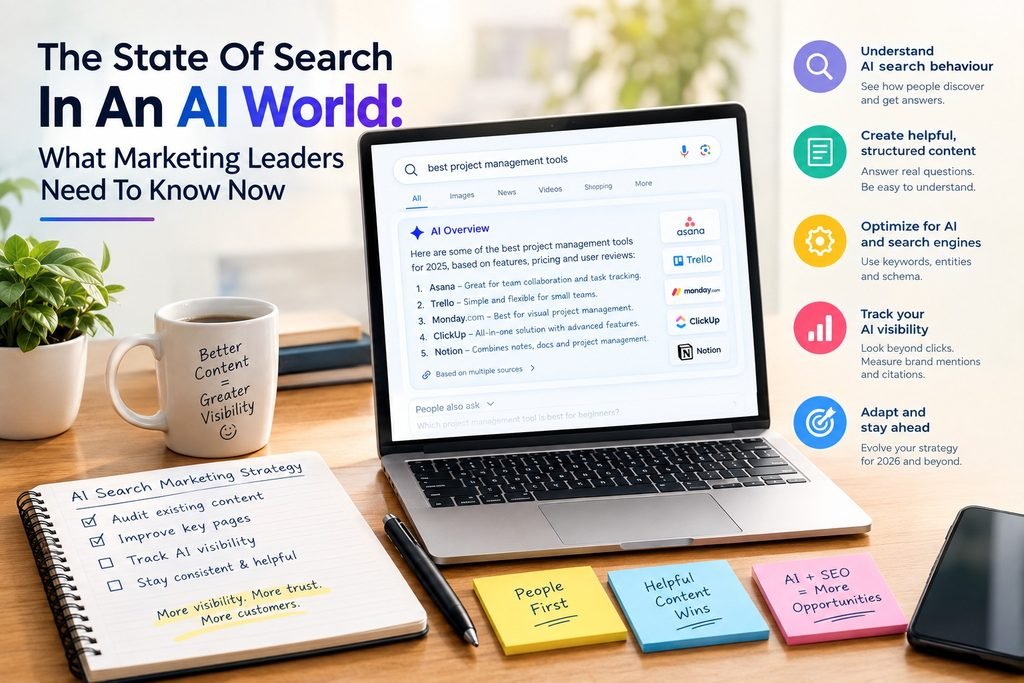
If your rankings haven’t moved but your traffic has, you’re not imagining things. AI search marketing strategy isn’t a buzzword anymore — it’s the difference between brands that stay visible and brands that quietly disappear from the customer journey. The old rule was simple: rank #1, get the click. That rule is breaking down in real time, and marketing leaders who are still measuring success by position alone are flying blind.
This isn’t theory. It’s based on what’s actually changed for real businesses over the last year, including a strategy shift that produced measurable results for one of my own clients.
The Moment SEO Stopped Being Enough
The wake-up call wasn’t subtle. Rankings held steady, but clicks started dropping anyway — because AI-generated answers were sitting above the organic results, answering the question before anyone scrolled down.
That’s not a fluke. Independent research backs it up. Ahrefs’ analysis of 300,000 keywords found that when an AI Overview appears, the top-ranking page’s click-through rate falls by 58% on average. Reported data shows organic click-through rates falling from around 1.76% to about 0.61% when an AI Overviewhttps://en.wikipedia.org/wiki/AI_Overviews is present — roughly a 60% drop. Ranking #1 below an AI answer is, functionally, still page two.
The takeaway for marketing leaders: visibility inside the answer now matters more than position on the page.
Zero-Click Search Is the New Normal
This isn’t limited to a handful of queries. Zero-click searches sit at around 34% on Google without an AI Overview, climb to roughly 43% when one appears, and reach as high as 93% inside Google’s AI Mode. In other words, for a growing share of searches, the visit to your website simply never happens — the answer is delivered on the results page itself.
This is the uncomfortable truth marketing leaders need to sit with: traffic is no longer the only signal of search performance. Brand recall, citation, and inclusion in AI answers now carry real weight, even without a click attached.
A Real Client Example: What Changed and What Happened
Theory is easy. Here’s what this looked like in practice.
For a local service-based business, the old approach was keyword-first: target a term, build a page around it, optimize the meta tags, move on. That stopped working as well once AI-generated answers started absorbing informational queries.
The strategy shift:
- Moved from keyword-first planning to intent-first, topically authoritative content
- Built out pages that answered real customer questions in full, rather than thin pages built to rank for a single phrase
- Structured content clearly (headers, direct answers up top, supporting detail below) so it was easier for both readers and AI systems to parse
Result: roughly a 20–30% increase in organic traffic, along with noticeably better on-page engagement. Not explosive growth — but a real, sustained improvement, driven by content that served people first and search engines second.
The Mistake That’s Quietly Hurting Brands
The most common misstep isn’t ignoring AI search — it’s overcorrecting for it. Teams start writing content for AI search instead of for the person asking the question. The result is generic, checklist-style content that technically covers a topic but says nothing memorable, offers no real point of view, and earns little engagement or authority.
AI systems, like search engines before them, are increasingly good at spotting content that exists only to be found — not to be useful. If your content wouldn’t hold up as genuinely helpful advice from an actual expert, it’s unlikely to earn a citation or a click either.
A Simple 3-Step Framework for Content in the AI Search Era
You don’t need a complicated new playbook. A workable framework looks like this:
| Step | What It Means | Why It Matters |
| 1. Understand real search intent | Go beyond the keyword — figure out the actual question behind it | AI systems reward content that fully resolves intent, not just content that mentions a term |
| 2. Create genuinely helpful, well-structured content | Clear headers, direct answers, real examples and experience | Structure helps both human readers and AI systems extract and trust your content |
| 3. Optimize for search engines and AI systems | Relevant keywords and entities, clear answers, supporting schema | Improves the odds of ranking and being cited or quoted in AI-generated answers |
This isn’t a replacement for SEO fundamentals — it’s an extension of them, with more emphasis on clarity, structure, and genuine usefulness.
What Marketing Leaders Should Actually Do This Month
If you’re still on the fence about how seriously to take this shift, start small and start now:
- Audit your top existing content. Identify which pages answer real customer questions clearly and which ones were built around a keyword and little else.
- Improve the pages that matter most. Prioritize the content most likely to be surfaced or cited in AI answers — usually informational, question-based content.
- Track your AI visibility. Monitor how (and whether) your brand shows up in AI-generated results, not just traditional rankings.
Waiting for AI search to “settle down” isn’t a strategy. The data shows this trend is not reversing — it’s evolving.
FAQs
Does SEO still matter if AI Overviews are reducing clicks?
Yes. Ranking well is often a prerequisite for being cited inside an AI-generated answer. SEO fundamentals haven’t disappeared — they’ve become the entry ticket rather than the finish line.
Should I stop creating informational content because of zero-click search?
No. Informational content is exactly where brand citation and authority-building happen, even without a click. The goal shifts from “earn the click” to “earn the mention.”
What’s the single biggest mistake brands make with AI search right now?
Producing generic content aimed at AI systems instead of real users. Content built for genuine helpfulness tends to perform better in both traditional and AI-driven search.
Conclusion
The state of search in an AI world isn’t about panic — it’s about recalibration. Clicks are down, zero-click search is up, and the brands adapting fastest are the ones treating AI search marketing strategy as an extension of good SEO, not a replacement for it. Understand intent, create content that genuinely helps, and structure it so both people and AI systems can trust it. That’s the playbook, and it’s working right now for businesses willing to make the shift.