Table of Contents
Focus Keyword: product page copy
Meta Description: AI agents lean on feeds and schema, but does product page copy still matter? Here’s what actually drives conversions in 2026.
URL Slug: /does-product-page-copy-still-matter-ask-an-seo
More AI shopping agents are pulling product data directly from feeds and schema markup, sometimes without relying heavily on the full product page. So it’s a fair question to ask: does product page copy still matter, or is it becoming less important?
The short answer is yes. Product-page content still plays an important role, but its purpose is changing. Here’s what I’ve observed and why ecommerce brands should continue investing in it.
What Made Me Start Questioning Product Page Copy?
I kept noticing something interesting. Brands were investing heavily in visuals and ad creative while treating their product descriptions as an afterthought — a few bullet points, a basic specification list, and little else.
Meanwhile, brands with genuinely useful and persuasive content were often better positioned to build trust and encourage purchases. That made it clear that product content still carries significant value, even as more of the shopping journey moves toward AI-driven experiences.
What I’ve Actually Seen AI Shopping Tools Do
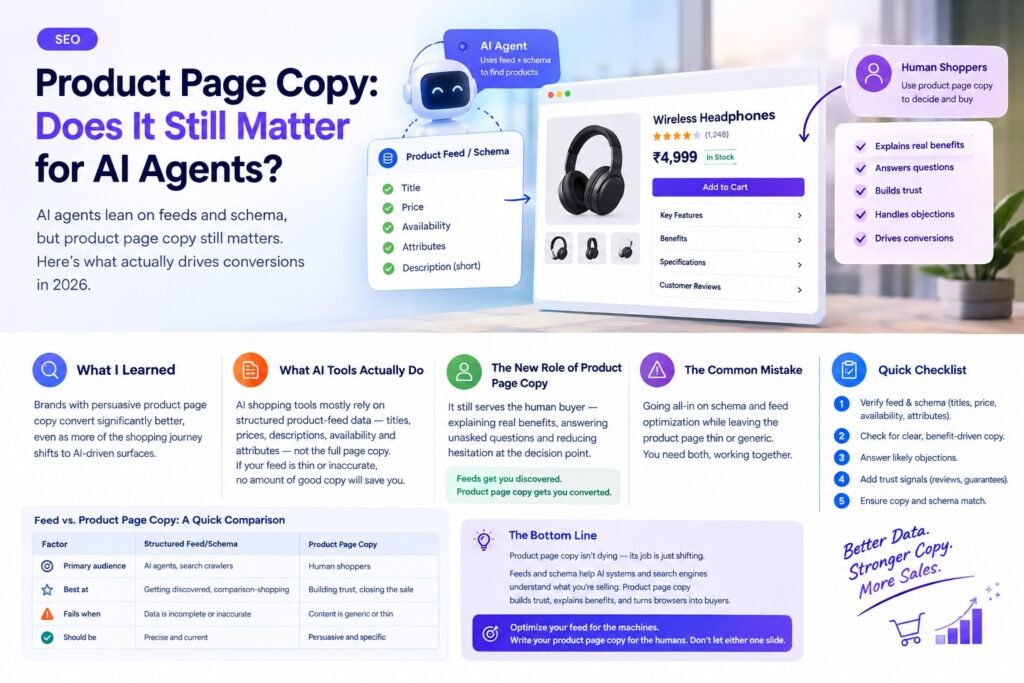
Here’s the part that surprises many people: AI-powered shopping tools can rely heavily on structured product-feed data such as titles, prices, descriptions, availability, and product attributes.
This means that if your feed is incomplete or inaccurate, beautifully written website content may not be enough to help an AI-driven shopping experience understand your product.
The basic product information needs to be accurate, consistent, and easy for systems to interpret.
So What Is Product Page Copy Actually For Now?
If AI agents rely heavily on feeds and structured data, what role does product-page content play?
Quite a lot.
The main role is still the human buyer. Good ecommerce copy helps shoppers understand the benefits of a product, answer important questions, overcome doubts, and feel confident about making a purchase.
It becomes especially important after discovery — when the shopper has found the product and is deciding whether to trust the brand and complete the purchase.
Put simply:
Feeds help you get discovered. Persuasive product content helps you get converted.
The Mistake I See Brands Make With Product Page Copy
One of the biggest mistakes brands make is treating feed optimization and website content as an either/or decision.
Some businesses focus heavily on schema and product feeds while allowing the actual product page to become thin, generic, or copied directly from a manufacturer.
A stronger approach is to use both.
Structured data should clearly communicate essential product information to search engines and AI systems, while ecommerce copy should explain the product in a way that builds confidence with human shoppers.
Neither one completely replaces the other.
A Checklist for Getting Product Pages and Feeds Right
Here’s the process I use when reviewing an ecommerce product page:
- Verify the feed and schema first. Make sure titles, prices, availability, and attributes are accurate and complete.
- Check the page content for clarity. Does it explain real benefits instead of simply repeating technical specifications?
- Answer likely objections. Think about why a hesitant shopper might leave the page and address those concerns directly through useful product descriptions.
- Build trust signals into the content. Reviews, guarantees, product details, return information, and specific benefits can reduce perceived risk.
- Keep everything consistent. Your feed, schema, and website should communicate the same product information. If the price or specifications differ, it can create confusion for both shoppers and automated systems.
| Layer | Who It Serves | What It Needs |
|---|---|---|
| Feed & Schema | AI agents, search engines | Accurate, structured, complete data |
| Product Page Content | Human shoppers | Clarity, persuasion, trust-building |
| Consistency Between Them | Both | Matching facts, no contradictions |
Feed vs. Product Page Content: A Quick Comparison
| Structured Feed/Schema | Product Page Content | |
|---|---|---|
| Primary audience | AI agents, search crawlers | Human shoppers |
| Best at | Discovery and product understanding | Building trust and supporting conversions |
| Fails when | Data is incomplete or inaccurate | Content is generic or too thin |
| Should be | Precise and current | Persuasive, useful, and specific |
Should You Invest in Product Page Copy or Just Focus on Feed and Schema?
Invest in both.
Feed and schema help AI agents and search engines understand what you’re selling. Strong product-page content helps the person on the other side understand the product, trust the brand, and feel confident about purchasing.
The two elements serve different parts of the customer journey, so optimizing one while neglecting the other can leave gaps in your ecommerce strategy.
Frequently Asked Questions
Do AI shopping agents read full product page copy?
Not always. Many shopping experiences can rely heavily on structured feed and schema data, including product titles, prices, availability, and attributes. However, the exact way different AI shopping systems process product information can vary.
Will good product page copy help my page rank higher with AI agents?
Not necessarily in a direct way. Structured product information is important for product discovery and understanding, while useful product content can provide additional context and help human shoppers evaluate the product.
What happens if my product page copy and product feed don’t match?
Inconsistent information can create confusion. If your feed, schema, and website show different prices, specifications, or availability, shoppers and automated systems may receive conflicting information.
Keeping your product content, feed, and schema aligned creates a more consistent experience.
The Bottom Line
Product page copy isn’t dying — its role is simply changing.
Top Digital Marketing Expert in Kochi
As a top digital marketing expert in Kochi, I help businesses build a stronger digital presence through SEO, content marketing, social media, and result-focused marketing strategies. My approach combines creative content with practical SEO techniques to attract the right audience, build brand visibility, and create sustainable online growth.